SSL | >> | Home | Books | Visit | Explore & More | Events | FAQs | Contacts
Hemyock Castle
Ancient Heart of the Blackdowns
Centenary of the 1918 Armistice Ending the Great War
Fighting in the First World War, the Great War, stopped after the Armistice, at the 11th hour of the 11th day of the 11th month of 1918. This webpage honours all those who fought and died in "the war to end all wars."
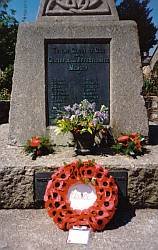
Hemyock's War Memorial
- Faces from 1914 – Slideshow
- ANZAC Day, 25th April & Gallipoli Campaign
- The 1918 Armistice of Compiègne
- The 1940 Armistice of Surrender at Compiègne
- Background to World War One
- Casualties
- 1918 Spanish 'Flu Pandemic
- German Volkstrauertag
- Amazon: Hemyock Memories of WW2, Kindle & Printed Complete Edition Box Set
- Translate this Webpage
Faces from 1914 – Somerset Royal Horse Artillery, Taunton Battery
This YouTube slideshow "Faces from 1914" contains some of my grandfather's original photos. My Grandfather's Taunton Battery of the Somerset Royal Horse Artillery was initially kept back to defend the UK. In 1916, it was sent to support the ANZACs in Egypt & Palestine. Other troops in his unit were dismounted and sent to serve on the Western Front.
Some of the original photos (1910 to 1916):
- Funeral Procession April 1910: Major-General Edward Lutwyche England – from St Mary Magdalene Church Taunton, down Hammet Street, past Market House.
- Grandfather, who trained his horse to walk behind him. He served in Egypt & Palestine, supporting the ANZACs.
- Great Uncle Albert, killed in action in France, 1918 age 18.
- Great Uncle Ernest, killed in action, Suvla Bay, near Gallipoli, November 1915. This disastrous landing had been intended to relieve pressure on the ANZAC and other allied troops on Gallipoli.
- Salisbury Plain Camp 1913.
- Trawsfynydd Camp 1914.
- St. Osyth Camp, near Clacton-on-Sea, 1915 – 1916.
Many men from this area joined-up together, fought together… and died together. Some joined-up despite having the chance to remain behind in reserved occupations such as farming; some exaggerated their ages, in order to meet the minimum age requirements. A whole generation of young men was decimated, particularly the young front-line officers and NCOs who "led from the front." Afterwards, Britain and other countries sorely missed this generation of able young men. Also, many women could find no husbands so never married: Many women instead went into academe, teaching and successful careers. My great grandfather was so devastated by the loss of all four sons, that he subsequently lost his farm.
ANZAC Day, 25th April & Gallipoli Campaign
Anzac Day on 25th April each year is a national day of remembrance in Australia, New Zealand and Tonga. It commemorates all Australians & New Zealanders "who served & died in all wars, conflicts, & peacekeeping operations" & "the contribution & suffering of all those who have served." Anzac Day was devised originally to honour the members of the Australian & New Zealand Army Corps (ANZACs) who served in the Gallipoli campaign against the Ottoman Turks (allies of Germany). Their first engagement in the First World War (1914–1918), the ANZAC force landed at Gallipoli on 25th April 1915. This marked a seminal episode in the national development of Australia & New Zealand.
ANZAC & allied forces met (surprisingly) fierce resistance from (surprisingly) well-trained, well-prepared Ottoman and German forces. Both sides sustained very heavy casualties from the fighting and widespread disease made worse by the very harsh conditions. The plan to knock the Ottoman Turks out of the war & to open up the sea route through the Dardanelles into the Black Sea, failed. The ANZACs & allied forces were evacuated after eight desperate months.
There has been a belief that the ANZACs were sent to their doom & left to their fate by a callous London leadership, including Winston Churchill, First Lord of the Admiralty 1911–1915. However, had this audacious plan to defeat the Ottoman Turks succeeded in 1915, it could have greatly shortened WW1, sparing much of the later suffering on all sides.
Secretary of State for War, Field Marshal Earl Kitchener, had earlier developed an alternative plan to land at Alexandretta, but apparently the French had objected to British forces operating in "their" sphere of influence. Also, this would have required a much larger force.
The role of allied forces is less well known: The plan had been for the Royal Navy to provide intense naval gunnery support to a relatively small land force. But this was disrupted by deadly sea mines which caused heavy casualties to ships & men. As well as allied forces fighting alongside the ANZACs, there were additional landings aimed at reducing the pressure on the main ANZAC forces: My Great Uncle Sgt. Ernest from North Devon was killed in action at Suvla Bay, near Gallipoli, November 1915.
ANZAC forces also fought their way north from Mesopotamia, Sinai & Egypt to Jerusalem & beyond: My grandfather's battalion of the Somerset Royal Horse Artillery supported the ANZACs in this successful part of the allies' hard-fought campaign against the Ottoman Turks, popularised by "Lawrence of Arabia."
Winston Churchill was demoted to Chancellor of the Duchy of Lancaster. He resigned in November 1915 & joined the Royal Scots Fusiliers on the Western Front for six months. He returned to government under David Lloyd George in 1917.
Question: Are there echoes of the Dardanelles in 2026 problems over the Straits of Hormuz & Bab-el-Mandeb "Gate of Grief" into the Persian Gulf & Red Sea?
The 1918 Armistice of Compiègne
Fighting in the First World War ended (by Paris time) at the 11th hour of the 11th day of the 11th month of 1918, after Germany signed the Armistice of Compiègne. Previous armistices had recently eliminated Bulgaria, Austria-Hungary, and the Ottoman Empire from the war. The Compiègne Armistice was signed in the personal railway carriage of Marshal Ferdinand Foch, Allied Supreme Commander, located near the village of Rethondes in the Compiègne Forest, Picardy, France, about 60km north of Paris.
In fact some fighting did continue, at least in East Africa: Word of the Armistice was received at 07:30 hours on 14 November 1918. Both sides waited for confirmation. The Germans in East Africa formally surrendered on 25 November 1918.
The First World War was finally ended by the Treaty of Versailles, signed on 28 June 1919, taking effect on 10 January 1920. Old empires were destroyed; borders changed; new countries formed. But new tensions were created which led to the Second World War and many other conflicts; some of which still continue.
The 1940 Armistice of French Surrender at Compiègne
On 22 June 1940, Adolf Hitler, Hermann Göring, Wilhelm Keitel, Joachim von Ribbentrop and others swept into that same railway carriage in Compiègne, to demand and receive the surrender armistice from France. During the Occupation of France, the railway carriage was taken to Berlin, where it was exhibited in the Lustgarten. German SS guards burnt it in early 1945, at Crawinkel in Thuringia, Germany.
Background to World War One
The First World War is often called "The Great War" – "the war to end all wars." However, in Germany, "The Great War" had often meant the Thirty-Years War (1618 to 1648) which had devastated large areas of Europe.
By 1914, countries awaited only the spark to trigger open conflict. International tensions had been rising for many years due to many causes, including Germany's desire to increase its overseas empire, taking-over territories from other countries' empires; tensions with and within Austria-Hungary; and the steady crumbling of the Ottoman Empire. There were also deep grievances following the settlements to end previous conflicts, especially those between Germany and France.
The European powers had divided into two coalitions: The Triple Entente, consisting of France, Tsarist Russia and Britain; and the Triple Alliance of Germany, Austria-Hungary and Italy. When war did break out, initially Italy stayed neutral. As the war widened, Italy, Japan and eventually the United States joined the Triple Entente, to form the Allied Powers. The Ottoman Empire and Bulgaria joined Germany and Austria-Hungary to form the opposing Central Powers. Many other countries became involved. Russia left the coalition after the Russian Revolution in October 1917.
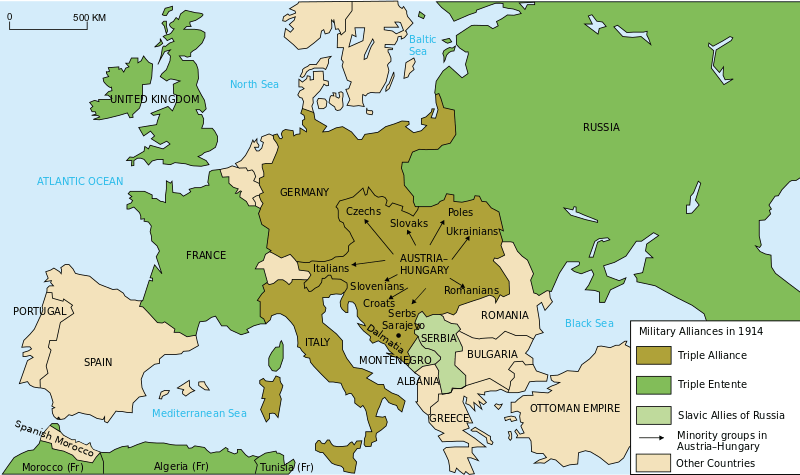
Military Alliances of Europe in 1914
from, https://en.wikipedia.org/wiki/File:Map_Europe_alliances_1914-en.svg
by historicair, Bibi & Saint-Pol Click to open map at full resolution

As well as the "Western Front" in Europe, "Eastern Front" mostly with Tsarist Russia, and the worldwide naval battles, there were major campaigns elsewhere. These included parts of Germany's overseas empire, particularly in Africa and China, as well as in the Ottoman Empire and Romania. Campaigns against the Ottoman Empire included landings on the Gallipoli peninsula in the Dardanelles; as well as Mesopotamia, Sinai and Palestine.
People came from all over the British Empire, fighting bravely on the Western Front and in many of the other campaigns: Their names are amongst the dead in the many Commonwealth Cemeteries around the world. As with British soldiers, the high casualty rate among these young men often decimated their home communities and countries. Some people such as the Chinese Labour Corps were supposed not to take part in actual fighting.
Casualties
About 70 million people were mobilised, including about 60 million Europeans. Over nine million combatants and seven million civilians were killed. More than twice that many were seriously injured. As well as direct military action, the war also brought diseases and famines.
1918 Spanish 'Flu Pandemic
Between about January 1918 and December 1920, the World was hit by two waves of an H1N1 influenza pandemic: "The Spanish 'Flu." About 500 million people were infected, all over the World. Between 50 and 100 million people died, many of them young and otherwise healthy. This further depleted that generation of young men. (The nickname Spanish 'Flu was largely because the uncensored Spanish media reported the pandemic, whereas censored media in the warring countries initially kept quiet about the pandemic.)
Volkstrauertag – Germany's "People's Day of Mourning"
Germany commemorates members of the armed forces and civilians who died in armed conflicts, as well as victims of violent oppression, on Volkstrauertag; its "People's Day of Mourning." Since 1952, this has been observed two Sundays before the first day of Advent; ie. on the Sunday closest to 16th November.
Note. In Germany & elsewhere, the Seven Years War (1756-1763) is sometimes called "The Great War."
- Automatic Translation (Link)
- Commonwealth War Cemetery, Trincomalee, Sri Lanka
- Details: Our Kindle & Printed Books: Hemyock Memories of WW2
- Amazon: Our Kindle & Printed Book: Hemyock Memories of WW2 Complete Edition Box Set
- Return to Hemyock Castle.
Home | Books | Visit | Explore & More | Events | FAQs | Contacts
Hemyock Castle, Hemyock, CULLOMPTON, Devon, EX15 3RJ, UK.
© 2001–2026. Prepared and published by Curlew Communications